Arabic mehndi designs are not so different form Indian and Pakistani mehndi designs. Arabic mehndi designs are not so rigid but their rigidity depends on the occasion.
Showing posts with label Islamic Art Gallery. Show all posts
Tuesday, August 9, 2011
Eid India Mehndi Designs
Eid India Mehndi Designs a lot of cultural significance in Indian traditions. Be it weddings, Karva Chauth or other occasions, mehndi plays an important role in all the ceremonies and festivals of India.
Eid Pakistani Mehndi Designs
Eid Pakistani Mehndi Designs since the identify suggests are a lot more frequent for the individuals while in the Pakistan. Nevertheless their popularity is throughout the world and they may be acknowledged for being extremely reputed mehndi styles.
The majority of the Eid Pakistani Mehndi Designs are recognized to possess really complex styles at the same time as designs.
Tuesday, April 12, 2011
Islamic Art Museum
It isn’t often that a building stuns – literally. However, this is the case with the Museum of Islamic Art in Doha, the capital of Qatar. Traditional Islamic architecture meets the twenty first century to spectacular effect.
Nothing is done by halves here. Even the palm lines entrance (and entrancing is perhaps the right word) fills the visitor with expectation. Sublimely designed by IM Pei, the museum opened its doors to the public less than two years ago.
The building is, as you might expect, heavily influenced by ancient Islamic architecture but its design is unique and there is simply no other building like it on earth. Certainly as a museum of this king it was the first in the Persian Gulf and its sheer size alone, over forty five thousand square meters, is a testament to the ambition of its designers.
Sabhia al Khemir became the founding director of the museum in 2006. A globally renowned Tunisian writer she is also expert in Islamic art and is best known for her work in bridging cultural divides and creating dialogue between the great civilisations of the world. Certainly the Museum of Islamic Art (or QIA as it is known) is an incredible talking point.
Image Credit Flickr User websterkate
The idea that contemporary Islamic culture is inward looking was contradicted from the word go by the invitation to IM Pei to be the chief architect of the project. The Chinese born American considered by many to be a master in his field was gently coaxed out of retirement to design the building. Most agree he has done a stupendous job. You may know him for, among many other projects, the glass pyramid outside the Louvre.
One of the first things that Pei did was to politely decline all of the proposed sites for the museum. This building – if it was to stand – had to stand alone. Doha happens to have a corniche – a waterfront promenade which is paralleled by a road. Perfect. So it was that it was eventually built on a sixty acre island off the corniche.
But what lies within? Surely something so spectacular on the outside must only be something of a disappointment on the inside. chacun à son goût, of course, but this is not the case with this particular building – whatever your own taste, disappointment is hardly the word.
The foyer itself is a grandiose mix of marble, steel and glass. As with the exterior the hard edges of modernism combine sublimely with the curves of traditional Islamic design. Now, look up...
From one of the upper levels, the view down is just as staggering. Just as the architecture is both traditional and progressive, so are the ideas behind the museum. Although built with the children of Qatar in mind primarily, the museum’s aim is to educate people about Islamic art and indeed the heritage of the Islamic world in general. What is often a misunderstood culture and history can be seen here and the visitor is, by being enabled to study the past then in more of a position to understand the present.
In fact, the whole place is a mathematician’s dream. The idea of the place is to give the visitor not only access to a wonderful and invaluable series of art works but to allow them to journey through time and across cultures, religions and eras.
Even the cafe has its own unique appeal. Oh, yes. There are the exhibits to...
Once you are done gasping at the architecture you may want to turn your attention to the exhibits. Here, too, you will not be disappointed. The museum is host to a significant collection of art which go from around the year 600 CE to the nineteenth century. There is something for every taste, from precious metals and stonework to glass and textiles.
Image Credit Flickr User zenat_el3ain
An important collection of manuscripts, spanning over a thousand years of Islamic literature is a fascinating glimpse in to an ancient and literate culture.
Times of both war and peace are represented here. This hugely important museum is little known outside of the Islamic world. Perhaps we should help spread the word?
Thursday, March 31, 2011
Passion for Perfection, Islamic art from the Khalili Collections in Amsterdam
De Nieuwe Kerk (New Church) in Amsterdam will present highlights from one of the world’s most renowned collections of Islamic art.
Passion for Perfection will include some 500 objects from the collection of Professor Nasser D. Khalili. From 11 December 2010 to 17 April 2011, De Nieuwe Kerk will glitter with richly illuminated Qur’ans and manuscripts, paintings, gold, jewels, textiles, ceramics, glassware, lacquerware, metalwork, and wood carvings.
These are works of great historical and artistic value, illustrating the refinement and grandeur of Islamic art and bearing witness to a quest for perfect craftsmanship. Passion for Perfection shows that Islamic art is a masterly expression, not of a single national culture or civilization, but of the many peoples joined by Islam for more than 1,400 years.
.
At the same time, the exhibition demonstrates the passion and expertise of Professor Khalili, who has assembled an unrivalled private collection of exceptionally fine Islamic art objects. The exhibition designer is Siebe Tettero, particularly known for his work for the Van Gogh Museum, the Rijksmuseum in Amsterdam, and the fashion house of Viktor & Rolf.
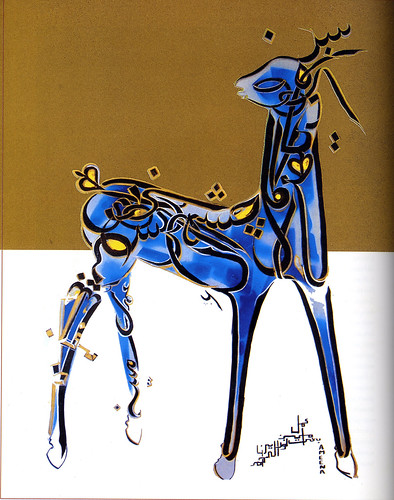
Calligraphic composition in the form of a lion - Ahmed Hilmi - Ink and watercolour on paper - Ottoman Turkey 1913
Besides calligraphic decoration and geometric patterns, arabesques and elegant scrollwork, there is also a strong emphasis on representations of humans and animals, the latter tolerated only in secular contexts. Many such representations are found in miniature paintings and in virtually all of the branches of the decorative arts.
One highlight is the Jami‘ al-Tawarikh, the first survey of Muslim history, written from the perspective of the Mongol conquerors by Rashid al-Din in 1314’1315.
This is the first time that such a large selection from the Khalili Collections is to be displayed in the Netherlands. The exhibition was previously shown in Sydney, Abu Dhabi, and Paris.War Mask - Anatolia or Western Iran -15th century
.
.
Drawing of two dervishes - Iran - 15th Century
.
.
Fath Ali Shah's portrait - Iran - 19th Century
.
.
Shirt of steel - Northen Caucasus (for Persian or Ottoman market) - late 15th century
.
.
Silver dirham - Konya
.
.
Turban ornament - South India - 19th-century
.
.
.
.
.
.
.
young Woman with Indian headdress - Ferdowsi's Shahnameh - Iran 1648
.
.
Dragon door handles - Jazira - 13th century
.
Sources: De Nieuwe and Khalili Collections
Subscribe to:
Posts (Atom)